– Add to your saved stories–You’re reading an excerpt from the Today’s WorldView newsletter. Sign up to get the rest free, including news from around the globe and interesting ideas and opinions to know, sent to your inbox every weekday.
–A few days after Hamas’s horrific Oct. 7 rampage through southern Israel, a top Israeli military official was blunt about his nation’s military response. Israeli security officials repeatedly stress the steps they take to minimize civilian harm and claim they are only striking legitimate military targets. –In recent days, Daniel Hagari, spokesman of the Israel Defense Forces, accused Hamas of “cynically” deploying its assets in civilian areas and near critical infrastructure, like hospitals. But when speaking in the offensive’s early stage, Hagari revealed that the “emphasis” of the IDF’s reprisal was “on damage and not on accuracy.”
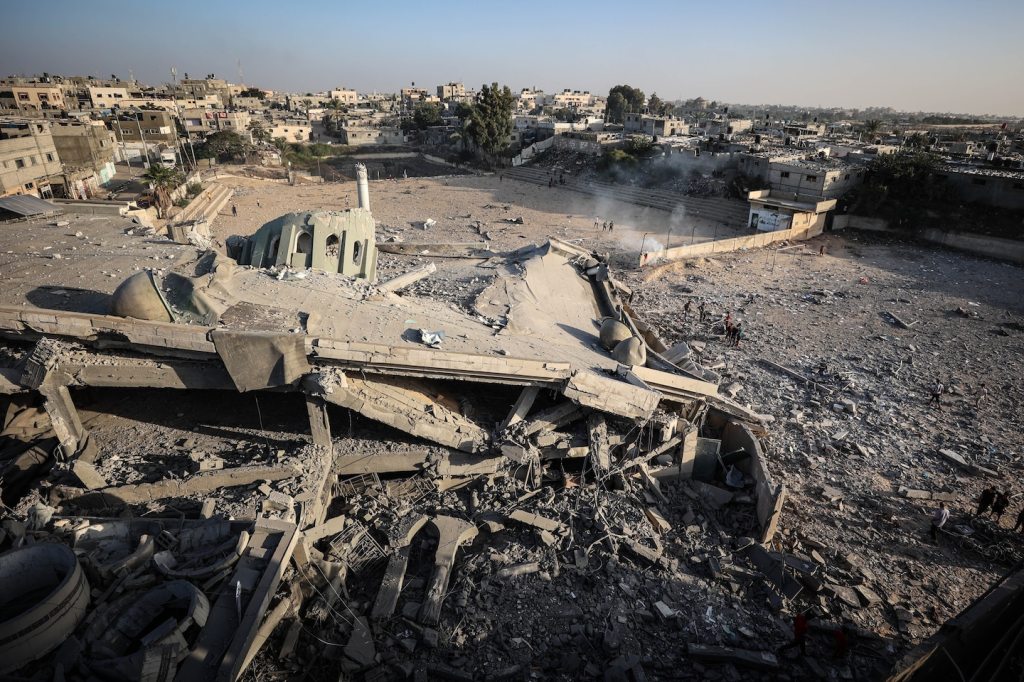
–At that time, Israeli warplanes had already dumped hundreds of tons of bombs on targets in the Gaza Strip. The ongoing campaign in the month since has claimed more than 10,000 lives in the besieged territory, including those of more than 4,000 children. It’s triggered a humanitarian crisis, displacing the bulk of Gaza’s 2.3 million people and driving tens of thousands into a desperate search for food, safety and water. Hunger and disease stalk Gaza’s blasted neighborhoods. Aid agencies place little hope in Israel’s latest decision to offer four-hour “pauses” in its operations so that residents in north Gaza can trek southward
–There are reams of commentary on what Israel’s strategy and endgame may be as it seeks to nullify the long-standing threat posed by Hamas and purge the Islamist militant faction from its Gaza redoubts. But looming behind it — and implicit in Hagari’s “emphasis” on damage over accuracy — is a long-standing Israeli military doctrine that appears to be in play now. –The so-called “Dahiya Doctrine” took shape in the wake of the bruising 2006 war between Israel and Hezbollah in Lebanon. Dahiya refers to the southern Beirut suburbs where Hezbollah maintained its strongholds and which were pummeled by Israeli jets after hostilities began when Hezbollah fighters abducted two Israeli soldiers. The onslaught then took Hezbollah by surprise, whose senior leadership had not expected to see their headquarters turned into rubble nor had planned for such a relentless bombardment.
–Around the same time, former Israeli colonel Gabriel Siboni wrote a report under the aegis of Tel Aviv University’s Institute for National Security Studies that argued the necessary response to militant provocations from Lebanon, Syria, or Gaza were “disproportionate” strikes that aim only secondarily to hit the enemy’s capacity to launch rockets or other attacks. Rather, the goal should be to inflict lasting damage, no matter the civilian consequences, as a future deterrent. –According to Rashid Khalidi, a Palestinian American scholar, these actions amount to collective punishment and probable war crimes.
–In the present environment, Israel’s right to self-defense has indeed been championed by lawmakers and commentators across the West. Given the unprecedented scale and horror of the Oct. 7 attack, there appears to be a hardened consensus in Israel that its military should do whatever it takes to neutralize Hamas. To that end, a host of Israeli politicians have called for the wholesale destruction of Gaza, the depopulation of the territory and even its resettlement by Israel. –Eisenkot is now a member of Israel’s unity “war cabinet.”
–No Israeli politician or security official has explicitly invoked the “Dahiya doctrine” as a template for the destruction unleashed in Gaza. ––Siboni added that Israel’s efforts to coax Palestinians in northern Gaza to flee to the south was a sign of its humanitarian approach.
“As for those who remain, too bad,” he said. “They choose to put their lives on the line.”




 Site Title
Leave a comment