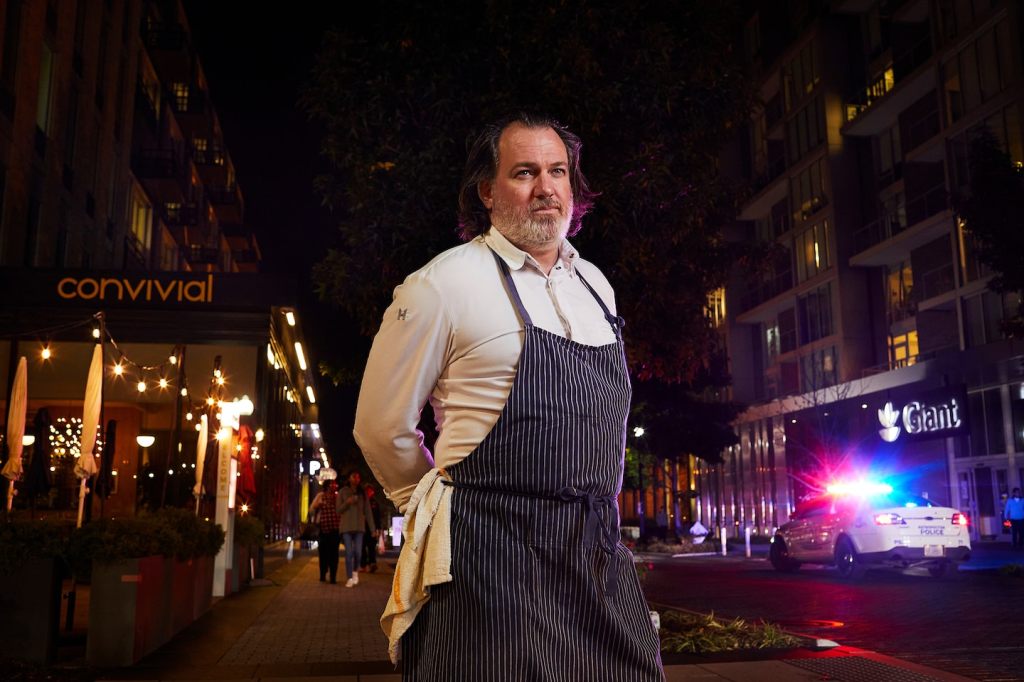
Cedric Maupillier was in the kitchen during a busy Saturday night at Convivial on Oct. 21. The chef didn’t hear the shots when several men exited a vehicle and opened fire at the Giant supermarket across the street in the Shaw neighborhood of Washington, D.C.
Diners and employees, Maupillier said, feared an active shooter was nearby. Customers hid under tables; one group turned over theirs to create a shield, sending plates, food and glasses crashing to the floor.
“No one was hurt inside the restaurant, though one man was injured in the gunfire outside the supermarket, according to a D.C. police report. This wasn’t a random act of violence, like the mass shooting on Oct. 25 at a bar and grill in Lewiston, Maine. This was part of a chronic neighborhood problem: It was the fourth time in the past few months someone had fired a gun within earshot of his restaurant, said Maupillier, who opened Convivial eight years ago in Shaw, which was then experiencing a revitalization.”
“Margins are already parchment-paper thin, and restaurants have struggled to remain profitable amid a crush of issues: the rising price of ingredients, changing dining habits, debt obligations and increased labor costs as some jurisdictions begin to phase out the tipped minimum wage or owners shell out more money to attract and maintain a stable crew.”
Nevertheless, in cities from San Francisco to Washington, D.C., crime is adding to those costs, or at least adding to the stress of getting people back into dining rooms at pre-pandemic levels.
“Rising food costs don’t work in our favor. Rising labor costs do not work in our favor. Economic uncertainty does not work in our favor,” Kennedy told The Post. “When you add that layer of something like people being concerned for their own personal safety, it puts unsustainable pressure on the nation’s second-largest employer.” “The city has become too easy for people to use drugs and cause mayhem. It’s not safe out there, and we need to change that,” one restaurateur commented in the association survey.
But those 8,300 reporting agencies represent only about 46 percent of overall police departments and don’t include major cities such as New York, San Francisco, Chicago or Washington, D.C.
“If you report too many crimes or burglaries, then the insurance company may drop you or even increase your rates,” says Nigel Jones, chef and owner of Calabash in Oakland, where violent crime this year is up by 22%



 Site Title
Leave a comment