Amazon in Crisis
Amazon in Crisis
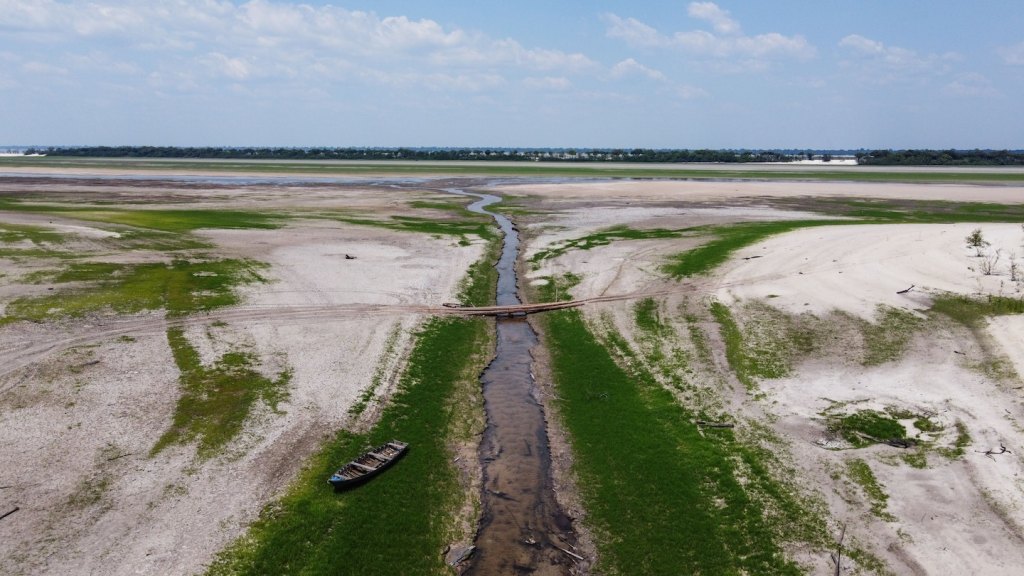
November 10, 2023 at 6:30 a.m. ESTView of an area affected by severe drought in the Rio Negro, Amazonas, Brazil, on Oct. 28. (Andre Coelho/EPA-EFE/Shutterstock)
Comment on this storyComment
The Amazon — the lush, tropical basin that holds the world’s biggest river, rainforest and a fifth of its fresh water — is running dry.
The region is entering its fifth month of a drought that has been particularly punishing in the northern reaches of the rainforest, in the region around the city of Manaus. The Rio Negro, a northern Amazon tributary, fell to the lowest levels in its recorded history last month. Wildfires have advanced where waterways have retreated.
“In my lifetime looking at drought impacts and fires, I’ve never seen so many wildfires happening so close to Manaus, a region that was not considered that flammable — or flammable at all — in the past,” said Paulo Brando, an associate professor at the Yale School of the Environment.
The effects of the drought are rippling through the forest. Travel and commerce along the river system have slowed to a crawl. Brazil shut down its fourth-biggest hydroelectric plant. Riverside cities and towns are rationing drinking water. Key fish species have struggled to spawn, threatening local food supplies, and endangered pink dolphins have washed up dead on the riverbanks.
As the rainy season returns, river levels are starting to recover. But scientists are predicting below-average rainfall that could leave the region vulnerable again next year.
This year’s disaster follows damaging droughts in 2005, 2010, 2015, 2016 and 2020. Each successive blow — combined with ongoing deforestation and rising temperatures — chips away at the Amazon’s ability to bounce back and puts it closer to a tipping point at which parts of the rainforest could permanently transform into a savanna.
A degraded Amazon would have big consequences for the world’s climate. The ancient forest stores 123 billion metric tons of carbon — more than three times as much as humans emitted last year — and its intact western region pulls millions of tons of carbon out of the atmosphere each year. But wildfires and deforestation have turned the eastern fringe of the forest into a net carbon emitter.
The rest of the forest could face the same fate.
“The global impact of that is very, very, very risky,” said Carlos Nobre, an earth system scientist at the University of São Paulo’s Institute of Advanced Studies. “When the forest is losing more carbon than it is absorbing from the atmosphere, that shows we’re on the edge of this tipping point.”
A rainforest on the brink
This year’s drought is linked to a strong El Niño, a climate pattern that often leads to drier conditions in the Amazon. Rising temperatures from human-caused climate change are probably intensifying the drought by speeding up evaporation of water from land surfaces. As summer and fall temperatures have sharply risen in Brazil in recent decades, average rainfall over the country has seen a steep decline.
Drought conditions over the rainforest region have reached the most extreme level over the last three months.
Big droughts used to rarely hit the Amazon — about once every 20 years or so, according to Nobre. But, due to climate change, they’ve come more frequently. “Unfortunately, in the last 20 years, this is becoming two strong droughts per decade,” he said. “That’s very much linked to global warming.”
Deforestation can also make droughts worse by making conditions drier.
The Amazon is so vast that it makes its own rain. Wet air from the Atlantic moves over land and dumps rain near the coast, watering the edges of the forest. The dense mass of vegetation releases moisture back into the air through a process called evapotranspiration. As winds blow that moist air deeper inland, more rain develops. The process repeats across the entire forest.
“That process simply needs the forest to be there in order to happen,” Boulton said. “If deforestation happens on the edge of the forest where the rainfall is coming in, there’s a breakdown in the ability for the forest to recycle” the water into the interior.

 Site Title
Leave a comment